
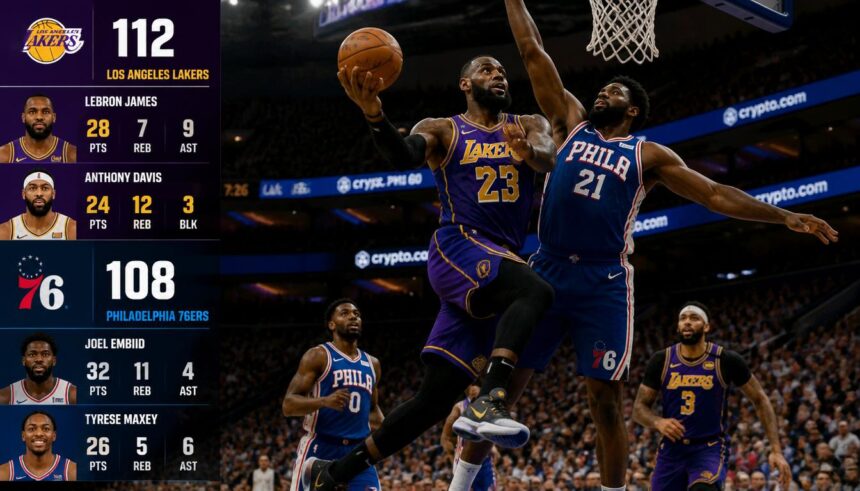
The Lakers vs 76ers match player stats give a clear picture of how this high-intensity matchup unfolded from start to finish. Instead of just focusing on the final score, the real story comes from individual performances, team balance, and how both sides adjusted under pressure.
- Game Overview: What the Stats Reveal
- Lakers Player Stats Breakdown
- 76ers Player Stats Breakdown
- First Half vs Second Half Statistical Shift
- Shooting Efficiency and Scoring Breakdown
- Rebounds, Defense, and Physical Battle
- Bench Impact and Role Players
- Turning Points That Defined the Game
- Tactical Analysis from Player Stats
- Final Summary of Player Stats
When we study the Lakers vs 76ers match player stats, it becomes obvious that this wasn’t just a star battle — it was a tactical game shaped by rebounds, turnovers, shooting efficiency, and clutch moments. Every possession mattered, and every player contributed in a different way.
As one basketball analyst once said, “A game is not defined by its result, but by the patterns hidden inside the box score.”
Game Overview: What the Stats Reveal
The opening phase of the match reflected a tight contest where both teams tested each other’s defensive setups. The Lakers vs 76ers match player stats show that neither side was able to build a large lead early on, mainly due to strong defensive rotations.
The Lakers focused on fast-paced transitions, while the 76ers relied on structured half-court sets. This contrast is clearly visible in the Lakers vs 76ers match player stats, especially in pace-related possessions and shot timing.
By halftime, the stats already hinted at a rebounding battle and efficient scoring inside the paint, which became the foundation of the entire game flow.
Lakers Player Stats Breakdown
The Lakers’ performance in the Lakers vs 76ers match player stats highlights a team heavily driven by its superstar duo and supported by selective bench contributions.
LeBron James controlled the offensive rhythm with strong playmaking and smart shot selection, while Anthony Davis dominated inside the paint with scoring, blocks, and defensive presence.
Lakers Key Statistical Contributions
- Strong interior scoring from Anthony Davis
- LeBron James leading assists and transition play
- Solid rebounding from frontcourt rotation
- Inconsistent three-point shooting across quarters
The Lakers vs 76ers match player stats also show that when the Lakers increased their tempo, their scoring efficiency improved significantly.
However, when the pace slowed, their reliance on isolation plays became more noticeable, affecting overall shot quality.
Austin Reaves and D’Angelo Russell provided spacing and perimeter support, but their output varied throughout the game, which is also reflected in the Lakers vs 76ers match player stats.
A common takeaway from analysts is, “The Lakers don’t just need stars to perform — they need rhythm across all five players.”
76ers Player Stats Breakdown
The 76ers’ numbers in the Lakers vs 76ers match player stats show a more structured offensive approach centered around Joel Embiid’s dominance.
Embiid was the focal point in the paint, scoring efficiently, drawing fouls, and forcing defensive adjustments that opened opportunities for teammates.
Tyrese Maxey added speed and scoring bursts, especially in transition, which helped Philadelphia maintain offensive pressure during key stretches.
76ers Key Statistical Contributions
- Joel Embiid dominating paint scoring and free throws
- Tyrese Maxey adding fast-break points and perimeter attacks
- Tobias Harris providing mid-range stability
- Bench players maintaining defensive discipline
The Lakers vs 76ers match player stats clearly show that Philadelphia’s offensive efficiency improved whenever Embiid drew double teams and passed out to open shooters.
One analyst described Embiid’s impact perfectly: “Even when he doesn’t score, he bends the entire defense around him.”
First Half vs Second Half Statistical Shift
One of the most important aspects in the Lakers vs 76ers match player stats is how the game changed after halftime.
In the first half, both teams were evenly matched with similar shooting percentages and rebound totals. However, the second half brought noticeable changes in pace and execution.
Key Shifts Observed
- Lakers increased transition scoring in spurts
- 76ers improved half-court execution efficiency
- Turnovers became more impactful in late quarters
- Star players took more isolation possessions
The Lakers vs 76ers match player stats suggest that fatigue and defensive adjustments played a major role in shaping second-half performance.
As one commentator put it, “The first half is about strategy, but the second half is about survival.”
Shooting Efficiency and Scoring Breakdown
The shooting data in the Lakers vs 76ers match player stats highlights a contrast between inside scoring and perimeter execution.
The Lakers were strongest in the paint, especially through Davis, while the 76ers showed better consistency in mid-range and free throw shooting.
Shooting Insights
- Lakers dominated paint points
- 76ers led in free throw accuracy
- Both teams struggled with long-range consistency
- Clutch shots favored the more structured offense
The Lakers vs 76ers match player stats also reveal that shooting percentages dropped slightly under pressure in the final minutes, which increased the importance of defense and rebounding.
Rebounds, Defense, and Physical Battle
The physical aspect of the game is clearly visible in the Lakers vs 76ers match player stats, especially in rebound distribution and blocked shots.
Anthony Davis anchored the Lakers’ defense with rim protection, while Embiid controlled defensive rebounding and interior presence for the 76ers.
Defensive Highlights
- Strong rim protection from Anthony Davis
- Embiid controlling defensive boards
- Perimeter pressure forcing turnovers
- Physical battles in the paint throughout the game
The Lakers vs 76ers match player stats show that second-chance points were a major factor, especially during momentum swings in the third quarter.
Bench Impact and Role Players
Bench performance often decides close games, and the Lakers vs 76ers match player stats highlight this clearly.
The Lakers bench provided energy in short bursts, especially in defensive sequences, while the 76ers bench contributed more stability and spacing.
Bench Contributions
- Lakers: energy-based impact in defense
- 76ers: consistent spacing and rotation support
- Limited scoring bursts from both benches
- Defensive substitutions shaping momentum
The Lakers vs 76ers match player stats suggest that neither bench dominated, but small contributions helped maintain balance during star rest periods.
Turning Points That Defined the Game
Several moments changed the direction of the match, and the Lakers vs 76ers match player stats help identify them clearly.
A key turning point came during a strong 76ers scoring run led by Embiid and Maxey, which shifted momentum and forced the Lakers to adjust defensively.
The Lakers responded with a defensive stretch led by Davis, which temporarily slowed Philadelphia’s offense.
Key Turning Moments
- 76ers third-quarter scoring run
- Lakers defensive adjustment with rim protection
- Late-game isolation plays from both teams
- Crucial turnovers in final minutes
As one analyst summarized, “Momentum in this game didn’t last long — it swung like a pendulum.”
Tactical Analysis from Player Stats
The deeper meaning of the Lakers vs 76ers match player stats lies in tactical execution.
The Lakers depended on pace and transition offense, while the 76ers relied on structured half-court setups built around Embiid.
Tactical Insights
- Lakers: fast-break dependency
- 76ers: structured offensive sets
- Defensive switching impacted shot quality
- Tempo control decided key stretches
The Lakers vs 76ers match player stats clearly show that whichever team controlled tempo had the advantage during that phase of play.
Final Summary of Player Stats
When reviewing the complete Lakers vs 76ers match player stats, the game stands out as a balanced battle between explosive athleticism and structured execution.
The Lakers excelled in transition and paint scoring, while the 76ers showed control in half-court efficiency and free throw execution.
In the end, the Lakers vs 76ers match player stats reflect a game decided by small margins — rebounds, turnovers, and clutch decision-making rather than one dominant performance.
As one final quote puts it, “Close games are never about who plays better overall — they are about who executes better in the last five minutes.”
Also Read: The Seattle Weekly