

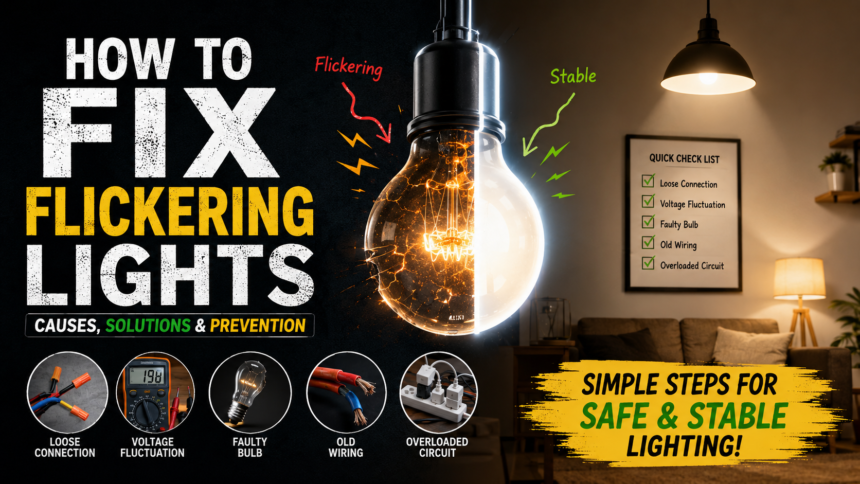
Flickering lights are more than just a visual annoyance. They can signal simple issues like a loose bulb, or deeper electrical problems such as unstable wiring or voltage fluctuations. Understanding how to fix flickering lights is important not only for comfort but also for safety.
- Loose or Improperly Fitted Bulbs
- Faulty or Aging Light Bulbs
- Voltage Fluctuations in the Home
- Faulty Light Switches
- Loose Electrical Wiring
- Incompatible Dimmer Switches
- Step 1: Check the Bulb First
- Step 2: Observe the Pattern
- Step 3: Test Without Appliances
- Step 4: Inspect Switches
- Step 5: Replace Suspect Bulbs
- Step 6: Check Electrical Load
- Old Wiring Systems
- Loose Neutral Connection
- Power Supply Issues from Utility Provider
- Practical prevention steps:
- Final Thoughts
In many homes, people ignore flickering for weeks or even months, thinking it’s normal. But in reality, it is often the earliest warning sign that something in your electrical system needs attention.
This detailed guide explains everything you need to know about how to fix flickering lights, from basic causes to advanced troubleshooting steps, prevention methods, and when to call a professional.
What Flickering Lights Really Mean
Before learning how to fix flickering lights, it is important to understand what flickering actually represents.
Electricity in your home flows through a controlled system of wiring, switches, and fixtures. When any part of this system becomes unstable, the flow of electricity becomes inconsistent. This inconsistency is what causes flickering.
Sometimes it is harmless, like a bulb not tightened properly. Other times, it can be a sign of deeper electrical instability.
A common electrician saying explains it well:
“Light flickering is not the problem—it is the symptom. The real issue is always behind the wall.”
Common Causes of Flickering Lights
Understanding the causes is the first real step in learning how to fix flickering lights. Each cause has a different solution, so identifying the root problem is essential.
Loose or Improperly Fitted Bulbs
One of the simplest causes is a loose bulb. If the bulb is not screwed in tightly, the connection between the bulb and socket becomes unstable.
Even slight movement can interrupt the current and create flickering.
Signs:
- Flickering when you gently tap the fixture
- Light turning on and off randomly
- Works fine after tightening
Real-life example:
Think of a phone charger that only works when you adjust the cable. A loose bulb behaves in the same way.
Fixing this alone solves many cases of how to fix flickering lights.
Faulty or Aging Light Bulbs
Sometimes the bulb itself is the problem. LED bulbs have internal drivers, and when these fail, flickering starts.
Older CFL bulbs are even more prone to this issue.
Symptoms:
- Constant flickering even after tightening
- Light takes time to stabilize
- Visible brightness changes
Replacing the bulb is often the fastest solution in how to fix flickering lights.
Voltage Fluctuations in the Home
Voltage instability is a more serious cause. When power entering your home is not stable, lights flicker across multiple rooms.
This often happens when heavy appliances start running.
Common triggers:
- Air conditioners turning on
- Water pumps starting
- Refrigerators cycling
As one electrician puts it:
“When your house shares power like traffic on a narrow road, lights will always show the congestion.”
Managing voltage is a key part of how to fix flickering lights long-term.
Faulty Light Switches
A worn-out switch can break internal contact, causing inconsistent power flow.
This is common in older homes where switches have not been replaced for years.
Signs:
- Flickering only when switching on
- Buzzing sound from switch
- Delayed response when turning on lights
Replacing switches is often necessary in how to fix flickering lights when basic fixes fail.
Loose Electrical Wiring
Loose wiring inside walls or junction boxes is a serious issue. It interrupts electricity flow and can become a safety hazard.
Warning signs:
- Flickering in multiple lights
- Lights dim when appliances are used
- Breakers trip occasionally
This is not a DIY-friendly situation. Professional help is usually required for how to fix flickering lights in such cases.
Incompatible Dimmer Switches
Modern LED bulbs often do not work properly with older dimmers.
This mismatch causes flickering, buzzing, or unstable brightness.
Fix:
- Use LED-compatible dimmers
- Replace non-dimmable bulbs
- Test lights at full brightness
Compatibility is often overlooked in how to fix flickering lights problems.
Step-by-Step Guide: How to Fix Flickering Lights
Now that causes are clear, let’s go step-by-step through how to fix flickering lights effectively.
Step 1: Check the Bulb First
Always start simple.
- Turn off the light
- Tighten the bulb
- If needed, replace it
This alone solves a large percentage of flickering issues.
Step 2: Observe the Pattern
Check where flickering occurs.
- One room only → local issue
- Whole house → electrical or voltage issue
Pattern detection is crucial in how to fix flickering lights.
Step 3: Test Without Appliances
Turn off major appliances and observe.
If flickering stops, the issue is likely voltage load imbalance.
Step 4: Inspect Switches
Gently test switches for:
- Loose movement
- Delay in response
- Buzzing sound
Replace if needed.
Step 5: Replace Suspect Bulbs
Try a new high-quality LED bulb.
Cheap bulbs often fail early and cause flickering.
Step 6: Check Electrical Load
Too many devices on one circuit can destabilize lighting.
Spread usage across different sockets.
Advanced Electrical Causes
If basic steps do not solve the issue, how to fix flickering lights becomes more technical.
Old Wiring Systems
Homes with old wiring may not handle modern electrical loads.
Over time, insulation weakens and resistance increases.
Solution:
- Partial rewiring
- Circuit upgrades
- Professional inspection
Loose Neutral Connection
A loose neutral wire can cause dangerous flickering across the entire house.
This is one of the most serious electrical issues.
Warning:
- Lights flicker unpredictably
- Appliances behave oddly
- Voltage seems unstable
This requires immediate electrician attention.
Power Supply Issues from Utility Provider
Sometimes the issue is outside your home.
If neighbors also experience flickering, the problem may be from the grid.
Real-Life Scenario Example
Imagine sitting in your living room at night. The light flickers every time the refrigerator starts.
At first, you ignore it. Then over time, it becomes worse. Eventually, even small appliances affect lighting.
This is a classic example of why understanding how to fix flickering lights early can prevent bigger electrical issues.
When You Should Call an Electrician
Not every issue should be handled alone.
Call a professional if:
- Flickering affects multiple rooms
- Burning smell is present
- Switches spark or heat up
- Breakers trip frequently
Electricians have tools to measure load, voltage, and wiring faults safely.
A professional once said:
“By the time flickering becomes visible everywhere, the problem has already grown inside the system.”
How to Prevent Flickering Lights in the Future
Prevention is the most important part of how to fix flickering lights long-term.
Practical prevention steps:
- Use high-quality LED bulbs
- Avoid cheap electrical components
- Upgrade old switches
- Balance electrical load
- Inspect wiring every few years
Small maintenance habits prevent big electrical problems.
Final Thoughts
Flickering lights should never be ignored. They might start small, but they often indicate underlying electrical instability.
By understanding how to fix flickering lights, you can quickly identify whether it is a simple bulb issue or something deeper like wiring or voltage imbalance.
Start with basic checks, observe patterns, and escalate only when necessary. A stable lighting system is not just about comfort—it’s about safety and long-term reliability.
Also Read: The Seattle Weekly