

Whether you’re hanging a picture, building furniture, or working on a DIY project, knowing how to read a tape measure is an essential skill. Many people feel confused when they first look at the small lines and numbers on a tape measure, but once you understand the basics, it becomes surprisingly simple.
- What Is a Tape Measure?
- Understanding the Basic Parts of a Tape Measure
- Understanding the Numbers
- What Do the Small Lines Mean?
- How to Read a Tape Measure Step by Step
- Step 1: Find the Last Whole Inch
- Step 2: Count the Fraction Marks
- Step 3: Write the Complete Measurement
- Visualizing Common Measurements
- Understanding Fraction Patterns
- Reading Metric Measurements
- Real-Life Examples
- Common Tape Measure Symbols
- Common Mistakes to Avoid
- Tips to Measure More Accurately
- Why Learning How to Read a Tape Measure Matters
- Final Thoughts
As the saying goes, “Measure twice, cut once.” Accurate measurements save time, reduce mistakes, and help every project turn out better.
In this guide, you’ll learn how to read a tape measure step by step, understand fractions, identify markings, and measure with confidence.
What Is a Tape Measure?
A tape measure is a flexible measuring tool used to determine length, width, height, or distance. Most tape measures in the United States use inches and fractions of an inch, while many others include metric measurements (centimeters and millimeters).
The numbered markings are easy to identify, but the smaller lines between the numbers often confuse beginners. Learning what these lines represent is the key to understanding how to read a tape measure correctly.
Understanding the Basic Parts of a Tape Measure
Before reading measurements, it helps to know the main parts.
Hook
The metal piece at the end of the tape is called the hook. It slightly moves back and forth to account for its thickness when measuring inside or outside surfaces.
Blade
The long metal strip with numbers and markings is called the blade.
Lock Button
Most tape measures include a lock that keeps the blade from retracting while you’re measuring.
Case
The outer housing protects the tape and contains the spring mechanism.
Knowing these parts makes learning how to read a tape measure much easier.
Understanding the Numbers
The large numbers on a tape measure represent inches.
For example:
- 1 = One inch
- 2 = Two inches
- 3 = Three inches
- 4 = Four inches
If an object ends exactly at the number 5, its length is 5 inches.
The challenge begins when the measurement falls between two numbers. That’s where the smaller lines come into play.
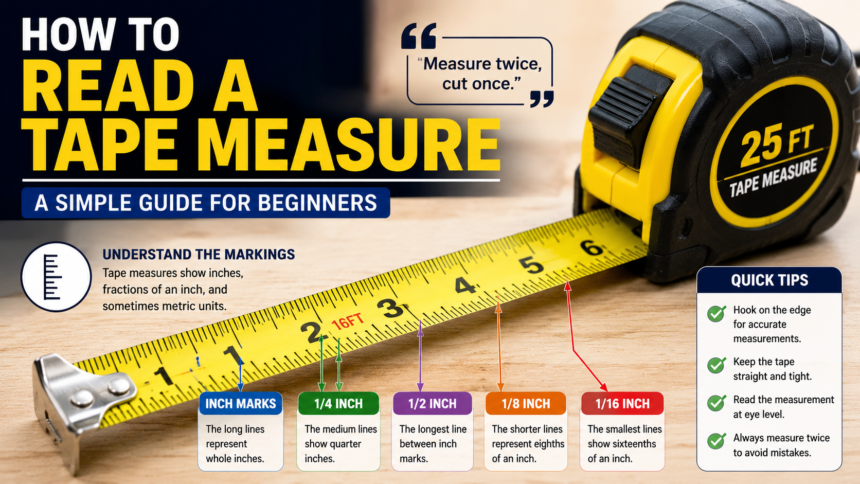
What Do the Small Lines Mean?
Each inch is divided into smaller sections.
Most standard tape measures divide an inch into:
- 1/2 inch
- 1/4 inch
- 1/8 inch
- 1/16 inch
Different line lengths help identify each fraction.
Longest Line
The longest line after each inch mark represents 1/2 inch.
Example:
- 1½ inches
- 2½ inches
- 3½ inches
Medium-Length Lines
These usually represent 1/4 inch increments.
Examples:
- 1¼ inches
- 1¾ inches
- 2¼ inches
- 2¾ inches
Shorter Lines
These represent 1/8 inch increments.
Examples:
- 1⅛ inches
- 1⅜ inches
- 1⅝ inches
- 1⅞ inches
Smallest Lines
The tiniest markings often indicate 1/16 inch increments.
These allow for highly precise measurements used in woodworking, construction, and detailed projects.
Understanding these divisions is one of the most important steps in learning how to read a tape measure accurately.
How to Read a Tape Measure Step by Step
Follow this simple process every time you measure.
Step 1: Find the Last Whole Inch
Look for the largest numbered inch mark before the object’s edge.
For example, if the edge falls between 7 and 8 inches, start with 7 inches.
Step 2: Count the Fraction Marks
Determine which line the object aligns with after the whole inch mark.
If it aligns with the fourth 1/16-inch mark after 7 inches:
7 + 4/16
Simplify:
7 + 1/4
Final measurement:
7¼ inches
Step 3: Write the Complete Measurement
Combine the whole number and fraction.
Examples:
- 5½ inches
- 8⅜ inches
- 12¾ inches
This method makes how to read a tape measure straightforward and reliable.
Visualizing Common Measurements
Many beginners benefit from memorizing the most common fractions.
1/2 Inch
Halfway between two inch numbers.
Example:
4½ inches
1/4 Inch
One quarter of the distance between inch marks.
Examples:
- 2¼ inches
- 6¾ inches
1/8 Inch
Smaller divisions commonly used in carpentry.
Examples:
- 3⅛ inches
- 5⅝ inches
1/16 Inch
The smallest standard division on most tape measures.
Example:
7 13/16 inches
The more you practice identifying these fractions, the easier how to read a tape measure becomes.
Understanding Fraction Patterns
One useful trick is recognizing fraction patterns.
Starting from zero, the marks often follow:
- 1/16
- 1/8
- 3/16
- 1/4
- 5/16
- 3/8
- 7/16
- 1/2
- 9/16
- 5/8
- 11/16
- 3/4
- 13/16
- 7/8
- 15/16
Learning this sequence helps you quickly identify measurements without counting every line repeatedly.
Reading Metric Measurements
Many tape measures include metric units on one side.
In the metric system:
- 10 millimeters = 1 centimeter
- 100 centimeters = 1 meter
The numbered marks usually indicate centimeters.
Smaller marks between them represent millimeters.
For example:
- 5.0 cm
- 5.1 cm
- 5.2 cm
- 5.3 cm
Metric measurements are often considered easier because they use a base-10 system rather than fractions.
Real-Life Examples
Measuring a Table
Suppose a table edge reaches halfway between 48 and 49 inches.
Measurement:
48½ inches
Measuring a Picture Frame
The frame ends at the third eighth-inch mark after 12 inches.
Measurement:
12⅜ inches
Measuring a Shelf
The shelf reaches the three-quarter mark after 24 inches.
Measurement:
24¾ inches
These examples show how practical understanding how to read a tape measure can be in everyday life.
Common Tape Measure Symbols
Many tape measures contain additional markings.
Black Diamonds
These often appear every 19.2 inches and are used in construction layout work.
Red Numbers
Red numbers usually indicate standard spacing used in framing.
Stud Marks
Some tape measures highlight common stud spacing distances, such as:
- 16 inches
- 24 inches
These features help professionals work faster and more accurately.
Common Mistakes to Avoid
Reading the Wrong Side
Some tape measures show inches on one edge and metric units on the other.
Always verify which scale you’re using.
Ignoring Fractions
A small fraction can make a big difference in construction or woodworking.
Even a 1/16-inch error can affect the final result.
Measuring from a Damaged Hook
A bent or loose hook may produce inaccurate measurements.
Check the hook regularly.
Rounding Too Early
Always record the exact measurement before rounding.
Precision prevents costly mistakes.
Tips to Measure More Accurately
Keep the Tape Straight
A curved or sagging tape can affect accuracy.
Lock the Tape
Use the lock feature to hold measurements in place.
Measure Twice
Professional builders follow the rule:
“Measure twice, cut once.”
This simple habit prevents wasted materials and unnecessary repairs.
Use Good Lighting
Proper lighting makes small fraction marks easier to identify.
Practice Regularly
The more measurements you take, the faster you’ll learn how to read a tape measure without hesitation.
Why Learning How to Read a Tape Measure Matters
Understanding how to read a tape measure is valuable for homeowners, DIY enthusiasts, students, and professionals alike.
It helps with:
- Home improvement projects
- Furniture assembly
- Woodworking
- Construction work
- Interior decorating
- Crafting projects
A few minutes spent learning measurement basics can save hours of frustration later.
Final Thoughts
Learning how to read a tape measure may seem challenging at first, but it becomes second nature with practice. Start by identifying whole inches, then learn the fraction markings between them. Once you understand how the lines are divided, measuring becomes quick and accurate.
Remember that every expert carpenter, builder, and DIY enthusiast started exactly where beginners start today. As one craftsman wisely said, “Accuracy is the foundation of quality work.” By mastering how to read a tape measure, you’ll gain a practical skill that will serve you in countless projects for years to come.
Also Read: The Seattle Weekly